A graphic novel on Connectivism — George Siemens' theory that in the digital age, learning is not stored in one head. It lives in the network you can reach. Read down, and the network builds itself around you.
Knowledge changes faster than any one person can keep up. So knowing where and knowing who now matter as much as knowing what.
Not the fact — the connection. Learning is the act of forming and maintaining links between people, tools, and sources.
Cut a learner off from the network and their capacity to know drops — regardless of how smart they are. Access is a learning condition.
Meet Amara. Watch what she can and can't learn — and notice it has less to do with her, and more to do with what she's plugged into.
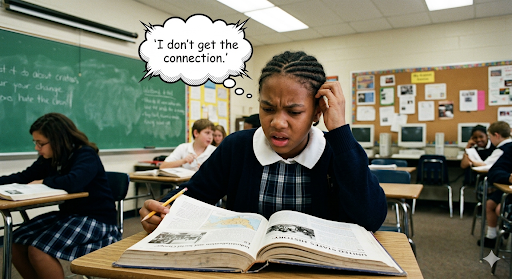
Amara has the textbook — a single, closed node. Everything she can know lives inside these pages, and the pages won't answer back. When the connection isn't there, neither is the learning. This is the pre-network learner: capable, stuck, alone.
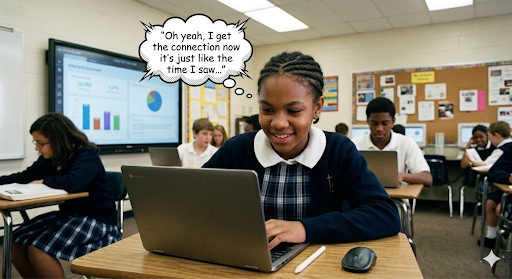
Same student, new node. The laptop links her to sources, examples, and a memory of something she saw before — she's forming connections, and understanding arrives the moment the network does. Siemens' core move: the learning didn't happen inside her head first. It happened across the link.
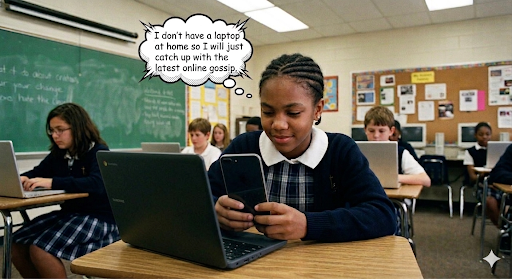
Here is the part the theory refuses to leave out. Amara has no device at home — so the moment school ends, her strongest links go dark, and her phone routes her to the nearest available node instead. The digital divide is not a side issue in Connectivism. It's the whole point: if learning lives in the network, then unequal access to the network is unequal access to learning.

X isn't stronger than Amara. He's more connected — every hand in that crowd is a node, and he's holding the links live. That's the whole promise of a connectivist classroom: the teacher's job stops being the source of all answers and becomes building the network — and making sure every learner, home device or not, has a way in.
Siemens says capacity to know lives in the connections, not the person. Don't take his word — turn the nodes off and read the meter. This is Panel 3 as a control you can operate.
Every node is live. Amara can reach the whole network — this is her at her most capable.
A slide deck would describe Connectivism. A comic that grows a live network behind it enacts it — the reader watches connections form in real time, which is the one thing the theory is actually about. Form carries the content.
Most Connectivism explainers stop at "learning is networked" and skip who gets left off the network. Panel 3 and the sever-the-network control make access a load-bearing part of the theory, not a footnote — because for the learners I design for, it is.
Amara is deliberately the same person in Panels 1–3. Nothing about her ability changes — only what she's plugged into. That isolates the variable the theory cares about and quietly rejects any "some kids just can't" reading.
X's power is the crowd behind him, not a solo gift. He reframes the instructor's role from answer-source to network-builder — the practical shift Connectivism asks classrooms to make.
Siemens, G. (2005). Connectivism: A learning theory for the digital age. International Journal of Instructional Technology and Distance Learning, 2(1), 3–10.
Downes, S. (2012). Connectivism and connective knowledge: Essays on meaning and learning networks. National Research Council Canada.